
5 Travel Stories to Film When Every Clip Looks Like Everyone Else’s
Another beautiful travel montage? Try five story-led filming approaches that turn choices, sounds and small discoveries into a more personal travel video.
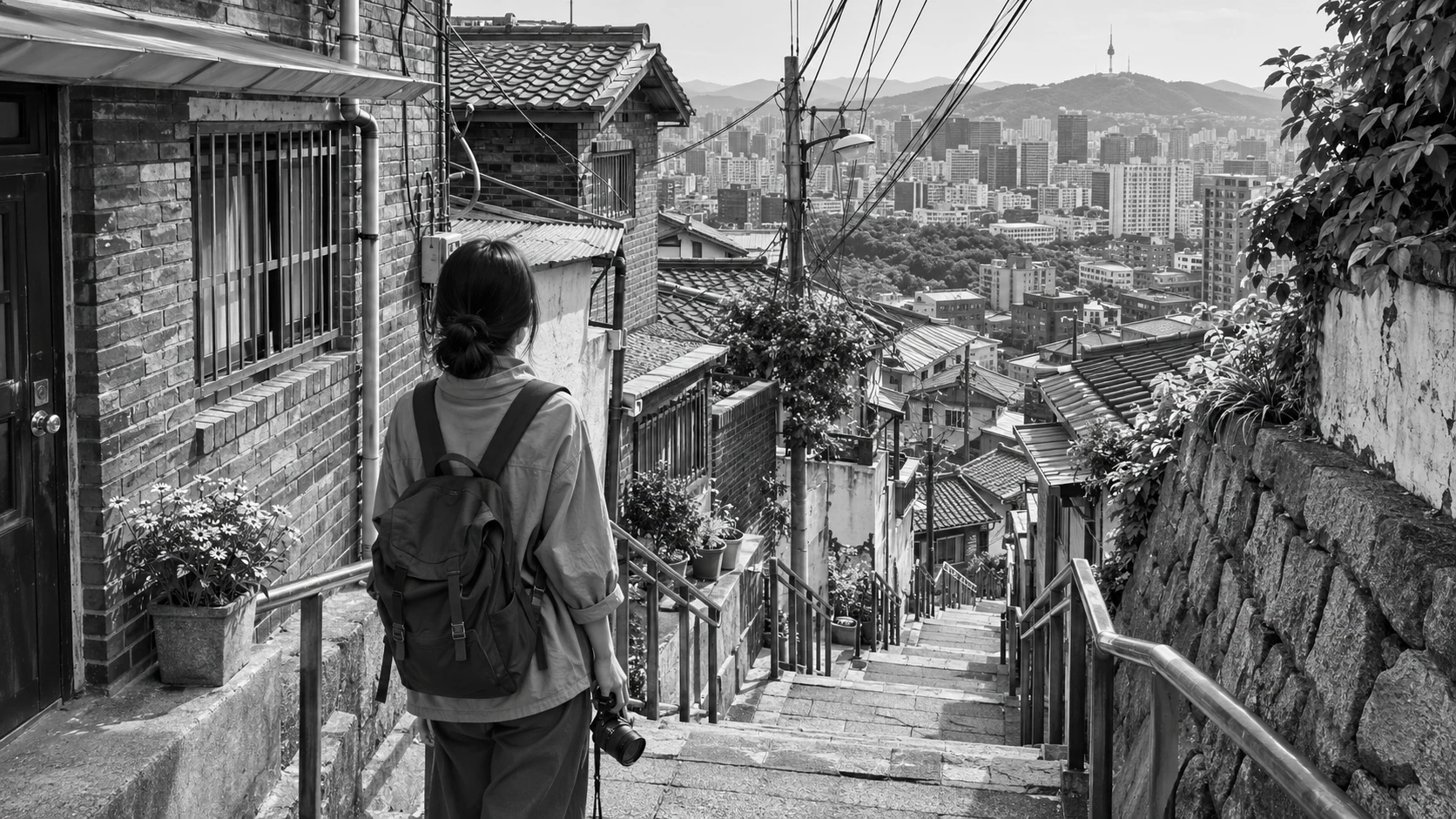
A full camera roll is not yet a story
Consider an illustrative editing problem: you return from a trip with a skyline, a meal, a café door and a train window. Each clip is attractive, but rearranging them changes very little. The sequence has no question. The same problem can happen in Seoul, Lisbon or the town beside your own home. A personal travel film needs more than proof that you visited a photogenic place. It needs something a viewer can notice with you.
The five approaches below turn ordinary travel decisions into filming plans. They are not destination rankings, hidden-gem claims or a reason to enter restricted spaces. A Korean neighborhood can be one setting among many, but the method is useful to creators of any background. Stay accurate about what you know. If you experienced a street for twenty minutes, describe that observation rather than presenting yourself as its cultural authority.
5 practical moves to try
Follow one small decision from start to finish
Choose an ordinary decision with visible consequences: walking a quieter route, arriving before a busy period or finding a place to pause between activities. State the purpose and show the actual choice. Record what happened without claiming that your result will be the same for everyone. The story does not need a crisis. A viewer can follow your priorities and decide whether the trade-off would suit their own trip, which gives the sequence more meaning than a collection of unrelated highlights.
Build a story around something you keep noticing
Perhaps you notice how workshops display tools, how a neighborhood opens in the morning or how public seating changes between streets. Collect a few examples with enough surrounding context to avoid turning them into decorative details. Explain the pattern you observed and where your knowledge stops. This gives the viewer a lens for looking, not a claim that you have discovered the definitive character of a place. A repeated question can also connect future trips without repeating the same itinerary.
Let an everyday process supply the sequence
Film a complete process you can access appropriately, such as preparing for a walk, setting up your own sketch or watching a permitted workshop demonstration. Capture preparation, action and the result instead of jumping straight to the attractive finish. Ask permission where required and do not interrupt someone’s work for a more convenient shot. A process gives the film natural progression while keeping the emphasis on observation and learning rather than presenting travel as a series of purchases.
Record the plan that changed
A missed opening time, unexpected weather or a route that feels different from the map can create a real decision. Explain the change accurately and keep its scale proportionate. Do not manufacture frustration or frame a minor inconvenience as a destination’s failure. Show how you reconsidered the day and what the alternative revealed. This approach can make the film useful because viewers see your decision process, not because the trip was perfectly planned or artificially dramatic.
End with a changed observation, not a generic montage
Return to the question you asked at the start. What do you understand differently, and which scene demonstrates that difference? You might revisit the same corner after learning how the street is used, or compare the route you expected with the one you actually chose. A modest conclusion can be satisfying when it belongs to the story. Leave broad claims about a culture or a city out of an ending supported by only a brief personal visit.
A travel story you can actually observe
The story belongs to what you observed; it does not have to claim authority over an entire destination.
Choose a question you can answer on the trip
Before leaving a location, record what you expected, what you noticed and what you would do differently. That short note can become narration later. Capture the scenes that establish the difference while you are still there. YouTube’s filming guidance asks creators to consider other people’s privacy. Build that consideration into the shot: use your own hands, empty details, public views and permission-based interactions instead of treating every passerby as background material.
Adobe’s B-roll guidance emphasizes supporting the main story. For travel, an extra beautiful shot is most useful when it reveals place, action or a detail connected to your question. If the story is about choosing a walking route, film the point where the routes differ. If it is about noticing a morning routine, capture the sequence of preparation rather than collecting isolated doors.
| Your starting material | Story question | Missing footage to capture |
|---|---|---|
| Two possible routes | Which choice fits my purpose? | The point where the routes differ |
| A repeated detail | What did I begin to notice? | Several examples with context |
| A plan that changed | What did the change make possible? | The decision and its consequence |
Practical questions
Do I need an unusual destination to make an interesting travel video?
No. A familiar location can support an interesting question when your observation is specific. Focus on a choice, process or change that you can show accurately. An unusual destination does not automatically provide a story, and presenting a busy place as undiscovered can mislead viewers. The useful distinction is your perspective and the evidence you captured.
How can I tell a travel story without filming people’s faces?
Use your own movement, environmental sound, architecture, accessible public views and details connected to the question. A route story can show junctions, surfaces and the moment you choose a direction. Avoid using identifiable strangers or private activities as convenient atmosphere. Where an interaction matters, ask permission and explain what you are making.
Should I write the story before travelling?
Prepare a question and a small shot plan, then leave room for what actually happens. Writing the ending in advance can push you to force observations into a conclusion. Keep a short note after each meaningful decision and review the footage before leaving a location. The final story can emerge from the evidence rather than a script that the trip never supported.
Turn this opportunity into a working brief
Review the points below and download a brief for your team. Your notes stay in this browser.
Sources and editorial context
The five travel structures are original editorial prompts, applicable internationally. They are not destination reviews, rankings or documentary claims about a location; the sources support limited filming principles.