
10 Ways to Break a Creative Block Without Waiting for Inspiration
Stuck on your next post? Try ten practical creative exercises that turn vague ideas into scripts, scenes and useful content you can actually start making.
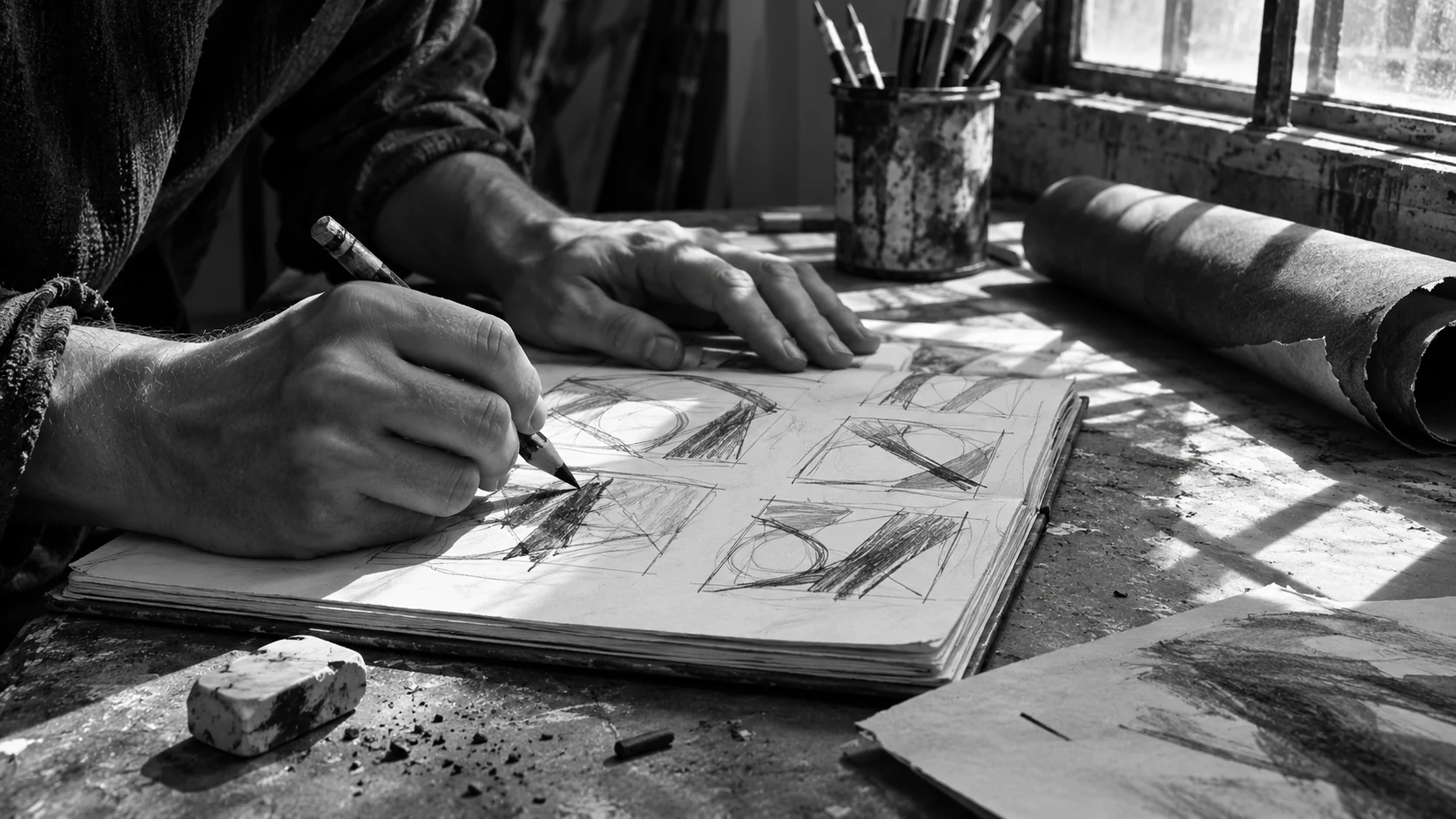
Replace the blank page with a smaller assignment
You have blocked out an afternoon to write a video, but the document still contains only a title. A typical response is to open more tabs, save more references and wait for a surprising idea. The amount of material grows while the decision remains untouched. This is a practical production problem: the assignment may be too vague to begin. A smaller constraint gives your attention somewhere concrete to go.
The exercises below are not a diagnosis or a treatment for persistent difficulty. They are ways to change the creative assignment. IDEO.org and Stanford d.school describe reframing challenges into open questions as a design practice. Here, that principle becomes specific exercises for scripts, visual stories and small creative teams. You do not need to use all ten in one session.
10 practical moves to try
Answer one question you keep explaining
Write down a question that repeatedly appears in your work, messages or conversations. Answer it for a person encountering the subject for the first time. The benefit is a defined starting point: you are no longer inventing a topic in the abstract, but improving an explanation that already has a reason to exist.
Turn a complaint into a practical challenge
Replace “our posts are boring” with a narrower question, such as how to show a useful decision without a talking-head introduction. A workable question permits several approaches. It also gives the team something to test, instead of asking someone to become more creative on demand.
Give yourself one visible constraint
Try explaining the idea with three objects, one location or a single continuous action. A constraint removes decisions and makes the remaining choices more interesting. Pick a limitation related to your production reality so the result could become an actual piece of content rather than a clever exercise you never use.
Start with the moment of change
Find the point where someone notices, chooses, learns or revises something. Draft that scene before the introduction. Starting with a meaningful action can reveal the real story beneath a broad topic. You can add the context afterward once you know what the viewer needs to understand.
Explain it to a different level of experience
Make two versions of the same answer: one for a beginner and one for someone already doing the work. The difference shows where you rely on unexplained assumptions. Choose the version that serves the intended audience rather than forcing everyone into a single explanation.
Build the deliberately rough version
Record a voice memo, sketch a scene order or assemble a low-detail draft using material you already have. Label it as a working version. The point is to make the idea available for judgment. You can improve a specific awkward transition more easily than a project that exists only in your head.
Borrow a structure, then change the substance
Study a format such as a comparison, a field note or a step-by-step demonstration. Use the underlying structure with your own research, examples and perspective. Do not copy someone else’s script or distinctive expression. A familiar container can free your attention for the value only you are trying to explain.
Ask a precise feedback question
Instead of “is this good,” ask what the viewer thinks they will learn from the opening. Show the draft without a long explanation first. Their answer exposes the gap between your intention and the material. Feedback becomes a production input rather than a vote on your ability.
Change how you collect observations
If every idea comes from the same feed, try a different input: sketch a physical process, record questions during a walk or observe how someone completes a real task with permission. Capture details rather than chasing an aesthetic. Fresh observations give a familiar subject something concrete to say.
End with the smallest next production action
Write the action that makes the rough idea more real: record the opening, obtain the missing source or film the comparison shot. Assign a sensible time and an owner. This closes the exercise with momentum you can use, rather than requiring another burst of inspiration before anything happens.
From stuck to something concrete
The exercise succeeds when it changes what you can do next, even before anything is published.
Choose the exercise for the actual obstacle
Name what is missing before choosing an exercise. If you lack a subject, audience questions may help. If the subject is clear but the video feels dull, a different opening or visual constraint may be more useful. Keep the unfinished output after the exercise. A rough artifact lets you identify the next edit, whereas an abstract feeling of progress disappears as soon as the session ends.
| Obstacle | Exercise to try |
|---|---|
| Too many unrelated ideas | One-question constraint |
| A familiar topic feels flat | Change the opening or viewpoint |
| Nothing exists to review | Build an intentionally rough version |
Practical questions
Should I keep brainstorming until I find an exceptional idea?
Set an output boundary. Once you have a workable direction that serves a real question, make a small version and learn from it. Endless options can delay the feedback that would actually improve the idea. Save alternatives so choosing one does not feel irreversible.
Can AI help with these exercises?
It can help generate angles or identify missing questions, but verify the output and bring your own observations. Do not publish fabricated examples, sources or personal experiences. The most useful role is assisting a defined task, not replacing the editorial decision about whom you want to help.
What if the exercise produces nothing publishable?
An exercise can still identify a missing fact, an unclear audience or a format that does not fit. Record that discovery and decide the next task. Do not force publication just to justify the time spent; use the work to reduce uncertainty about what to make next.
Turn this opportunity into a working brief
Review the points below and download a brief for your team. Your notes stay in this browser.
Sources and editorial context
These ten exercises adapt a general question-reframing principle to creator production. They are original editorial suggestions, not clinical advice or a measured ranking of techniques.